函数 定义和声明 1 2 3 4 5 6 7 8 9 10 11 12 13 14 15 #include <iostream> int add (int , int ) int main () int a = 6 , b = 9 ;int c = add (a, b);getchar ();return 0 ;int add (int a , int b) int c = a + b;return c;
函数参数 1 2 3 4 5 6 7 8 int func (int val) int func (int &val) int func (int *val) int func (int a, int b, int args ...)
1 2 3 4 5 6 7 8 9 10 11 12 13 14 15 16 17 18 19 20 21 22 23 24 25 26 27 28 29 30 31 32 33 34 35 36 37 38 #实例 数字交换#include <iostream> void func1 (int , int ) void func2 (int &, int &) void func3 (int *, int *) int main () int a = 6 , b = 9 ;func1 (a, b);"func1 ----> a:" << a << " b:" << b << std::endl; func2 (a, b);"func2 ----> a:" << a << " b:" << b << std::endl; func3 (&a, &b);"func3 ----> a:" << a << " b:" << b << std::endl;getchar ();return 0 ;void func1 (int a , int b) int temp = 0 ;void func2 (int &a, int &b) int temp = 0 ;void func3 (int *a, int *b) int *temp = 0 ;6 b:9 9 b:6 9 b:6
函数地址作为函数参数 1 2 3 4 5 6 7 8 9 10 11 12 13 14 15 16 17 18 19 20 21 22 23 24 25 26 27 28 29 #include <iostream> void swap (int &, int &) void func1 (int &, int &, void (*pf)(int &, int &)) int main () int a = 6 , b = 9 ;void (*pf)(int &, int &);"a:" << a << " b:" << b << std::endl; int c = 17 , d = 29 ;func1 (c,d,pf);"c:" << c << " d:" << d << std::endl; getchar ();return 0 ;void func1 (int &c,int &d,void (*pf)(int &,int &)) void swap (int &a, int &b) int temp = 0 ;9 b:6 29 d:17
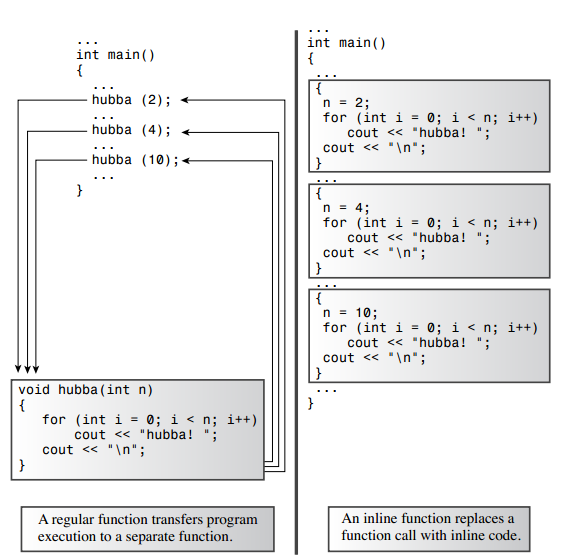
内联函数 常规函数的调用过程
1 2 3 4 5 6 7 8 9 10 11 12 13 14 15 16 #include <iostream> using namespace std;inline int Max (int x, int y) return (x > y) ? x : y;int main () "Max (20,10):" << Max (20 , 10 ) << std::endl;"Max (0,200): " << Max (0 , 200 ) << std::endl;"Max(100,1010): " << Max (100 , 1010 ) << std::endl;return 0 ;Max (20 ,10 ): 20 Max (0 ,200 ): 200 Max (100 ,1010 ): 1010
函数默认参数 带默认参数的函数 必须从右至左添加默认值
1 2 3 4 5 void func (int a,int b,double c = 3.14 ) void func (int a,int b = 2 ,double c) func (1 ,2 );func (1 ,2 ,3 );
类和对象 声明和定义 person.h 声明类person的头文件
1 2 3 4 5 6 7 8 9 10 11 12 #include <string> class person {public :person ();person (std::string name);std::string print_info (std::string name,int year) ;void print_name () void print () int add (int a,int b) return a + b}private :
person.cpp 定义类person中的函数和变量
1 2 3 4 5 6 7 8 9 10 11 12 13 14 15 16 17 18 19 20 #include "person.h" #include <iostream> #include <string> person (){};person (std::string name){std::string person::print_info (std::string name, int year) {"your name is " << name << " and your age is " << year << std::endl;return "hi " + name;void person::print_name () void person::print () "hello person " << std::endl;
main.cpp 使用person类
1 2 3 4 5 6 7 8 9 10 11 12 13 14 15 16 17 18 19 #include <iostream> #include <string> #include "person.h" int main () 1. print ();person p2 ("kyleson" ) ;2. print_name ();2. print_info ("kyleson" ,19 );getchar ();return 0 ;and your age is 19
常量成员函数 Date类中的成员函数(+const)表示函数为只读函数,不能对类Date的成员和状态进行修改
1 2 3 4 5 6 7 8 9 class Date {int d, m, y;public :int day () const return d; }int month () const int Date::month () const return Date::m;
mutable成员 mutable修饰的成员仍可被常量成员函数修改
1 2 3 4 5 6 7 8 9 10 11 12 13 14 15 class Date {int d, m, y;public :int day () const return d; }int month () const private :int century;mutable int cache;int Date::month () const 0 ;0 ;return Date::m;
自引用 1 2 3 4 5 6 7 8 9 10 11 12 13 14 15 16 17 class Date {int d = 12 , m = 6 , y =2018 ;public :Date& add_day () { d++; };Date& add_month () { m++; };Date& add_year () { y++; };private :int cache;mutable int modied;int main () add_year ().add_month ().add_day ();getchar ();return 0 ;
析构函数 类的析构函数是类的一种特殊的成员函数,在每次删除所创建的对象时执行
1 2 3 4 5 6 7 8 9 10 11 12 13 14 15 16 17 18 19 20 21 #include <iostream> using namespace std;class Line {public :Line (); Line (); Line (void ){"Object is being created" << endl;Line (void ){"Object is being deleted" << endl;int main () return 0 ;
友元函数 访问类的 private 和 protected 成员
1 2 3 4 5 6 7 8 9 10 11 12 13 14 15 16 17 18 19 20 21 #include <iostream> using namespace std;class Box {double width;public :friend void printWidth (Box box) void setWidth (double wid) void Box::setWidth (double wid) void printWidth (Box box) "Width of box : " << box.width << endl;int main () setWidth (10.0 );printWidth (box);return 0 ;
this 指针 1 2 3 4 5 6 7 8 9 10 11 12 13 14 15 16 17 18 19 20 21 22 23 #include <iostream> using namespace std;class Box {public :Box (double length = 2.0 ){int compare (Box box) return this -> length > box. length;private :double length; int main (void ) Box Box1 (3.3 ) ; Box Box2 (8.5 ) ; if (Box1. compare (Box2)){"Box2 is smaller than Box1" << endl;else {"Box2 is equal to or larger than Box1" << endl;return 0 ;
指向类的指针 1 2 3 4 5 6 7 8 9 10 11 12 13 14 15 16 17 18 19 20 #include <iostream> using namespace std;class Box {public : Box (double h = 2.0 ){double Volume () return length * breadth *height;private :double height; int main (void ) Box Box1 (3.3 ) ; "Volume of Box1: " << ptrBox->Volume () << endl;return 0 ;
类的静态成员 静态成员在类的所有对象中是共享的, 无论创建多少个类的对象,静态成员都只有一个副本
1 2 3 4 5 6 7 8 9 10 11 12 13 14 15 16 17 18 19 20 class Box {public :static int objectCount;Box (double h = 2.0 ){double Volume () return length * breadth *height;private : double height; int Box::objectCount = 0 ;int main (void ) Box Box1 (3.3 ) ; Box Box2 (8.5 ) ; "Total objects: " << Box::objectCount << endl; return 0 ;
继承 1 2 3 4 5 6 7 8 9 10 11 12 13 14 15 16 17 18 19 20 21 22 23 24 25 26 27 28 29 30 31 #include <iostream> using namespace std;class Shape {public :void setWidth (int w) void setHeight (int h) protected :int width;int height;class Rectangle : public Shape {public :int getArea () return (width * height); int main (void ) setWidth (5 );setHeight (7 );"Total area:" << Rect.getArea () << endl;getchar ();return 0 ;
多继承 1 2 3 4 5 class Shape {...};class PaintCost {...};class Rectangle : public Shape, public PaintCost {...};
虚函数和纯虚函数 virtual 修饰符 类中被声明为虚函数的函数在基类中实现也可被派生类重写.
1 2 3 4 5 6 7 8 9 10 11 12 13 14 15 16 17 18 19 class Shape {virtual int area () "Parent class area :" << endl;return 0 ;class Rectangle : public Shape {int area () "Rectangle class area :" << endl;return (width * height);class Shape {virtual int area () 0 ;
多态 多个派生类根据需要对基类的虚函数进行了不同的实现,在函数调用时会根据派生类的不同进行相应的调用
1 2 3 4 5 6 7 8 9 10 11 12 13 14 15 16 17 18 19 20 21 22 23 24 25 26 27 28 29 30 31 32 33 34 #include <iostream> using namespace std;class Shape {public :virtual void area () "Parent class area :" << endl;class Rectangle : public Shape {public :void area () "Rectangle class area " << endl;class Triangle : public Shape {public :void area () "Triangle class area " << endl;int main () area ();area ();getchar ();return 0 ;class area class area
运算符重载 1 2 3 4 5 6 7 8 9 10 11 12 13 14 15 16 17 18 19 20 21 22 23 24 25 26 27 28 29 class Date {public :int d = 12 , m = 6 , y = 2018 ;operator +(const Date &a);void operator ++();operator +(const Date & a){this ->d + a.d;this ->m + a.m;this ->y + a.y;return c;void Date::operator ++(){this ->y++;this ->m++;this ->d++;int main () getchar ();return 0 ;
异常处理 1 2 3 4 5 6 7 8 9 10 11 12 13 14 15 16 17 18 19 20 21 22 23 24 25 26 27 28 29 30 31 32 33 34 35 36 37 38 39 40 void task_master () try {auto result = do_task ();catch (some_error){int do_task () if (...)return result;else throw some_error{};#include <iostream> using namespace std;double division (int a, int b) if ( b == 0 ){throw "Division by zero condition!" ;return (a/b);int main () int x = 50 ;int y = 0 ;double z = 0 ;try {division (x, y);catch (const char * msg) {return 0 ;
C++标准异常
1 2 3 4 5 6 7 8 9 10 11 12 13 14 15 16 17 18 19 20 #include <iostream> #include <exception> using namespace std;struct MyException : public exception{const char * what () const throw () return "C++ Exception" ;int main () try {throw MyException ();catch (MyException& e){"MyException caught" << std::endl;what () << std::endl;catch (std::exception& e){
文件输入输出
1 2 3 4 5 6 7 8 9 10 11 12 13 14 15 16 17 18 19 20 21 22 #include <fstream> #include <iostream> #include <string> #include <cstdlib> int main () open ("test.txt" );if (fin.is_open () == false ){"cant not open the file \n" ;exit (EXIT_FAILURE);getline (fin,item);while (fin){"\n" ;getline (fin,item);"done" << "\n" ;close ();return 0 ;